


International law is having a moment. Most of the time, it is the exclusive purview and interest of a cadre of academics, scholars, lawyers, and diplomats. Despite being a generally-ignored concept for the vast majority of the public, it has been all over the news lately, and not just in relation to faraway lands. The term is often used with respect to foreign wars, and has been prevalent in that arena over the past few years, mostly in regard to Ukraine or Israel. But two significant news stories have seen international law become a talking point in domestic American political debates.
First came the push from New York City mayor-elect Zohran Mamdani to present the nation’s largest metropolis as “a city of international law.” He has repeatedly centered his policy prescriptions around this notion, including seeking to “uphold international law” by arresting any world figure with a warrant from the International Criminal Court (ICC). Naturally, this promise was made pretty much explicitly about one particular leader: Israel’s Benjamin Netanyahu. Mamdani’s obsession with using international law as a cudgel against Zionism, Israel, and American Jews did not stop there. Just after a vile antisemitic protest at a historic NYC synagogue, the mayor-elect’s spokesperson equivocated, “discourag[ing] the language” used by demonstrators while also suggesting that the “sacred space” was being “used to promote activities in violation of international law.” The event being held in part of the synagogue – others were simply there to worship and pray in accordance with their faith – was an informational session about the logistics for American Jews to migrate to Israel. This anodyne event, which did not, as opponents contend, involve the sale of so-called “occupied” territory, was an espousal of the most basic Zionism, an idea that is deeply intertwined with the Jewish faith.
At the same time, the invocation of international law by pundits and politicians alike has also attached to another issue: the Trump administration’s striking of Venezuelan narcotics fastboats in the Caribbean Sea.1 Some opponents of these strikes, especially international institutions and progressive commentators, have latched on to the idea that they violate international law as being a primary reason for their opposition.2 This attitude is perfectly represented by the UN High Commissioner for Human Rights, Volker Türk, who stated that these strikes “find no justification in international law,” and “violate international human rights law.” The purpose of invoking international law here is to present a power higher than that of any national government that binds the actions and choices of those sovereign states. That is the ostensible purpose of these institutions, ones that many American progressives like Mamdani see as nigh-infallible. And that gets to the heart of the issue.
The overlap between these two stories is not just that they both use the terminology of international law, but for what purpose they use that language. In both, those who invoke international law are seeking to use it as a weapon against people, actions, or events they simply dislike. Neither of these two issues are cut-and-dried cases of legal violations. They are not the mass murder of civilians, to put it mildly. In fact, much of the use of international law in this way is based on either egregious misstatements of the facts or a highly selective and overbroad application of the relevant legal framework. A case in point is the inordinate focus on Israel, accusing it of unspeakable crimes that never seem to pan out based on neutral information, as well as the application of rules that Israel itself never assented to. This just goes to show how farcical the whole international law regime has become. But it was not always this way.
The origins of international law – that is, not interstate treaties to end conflicts, but actual mutually-agreed regulations binding international conduct – lie firmly in Western civilization, dating back largely to the early modern period in Europe. The whole purpose of international law as such was to govern issues that are unimpeachably multilateral in nature. For instance, one of the first theorists of international law, the Dutchman Hugo Grotius (1583-1645), focused primarily on maritime issues and the management of the global oceanic commons in the Age of Discovery. This is an undeniably multinational issue that simply cannot be settled without basic agreed-upon rules of the road. Similar topics also formed the earliest corpus of international law, including the rules of armed conflict, handling of foreign prisoners, diplomatic protocols, and cross-border commerce.
These were not laws promulgated by large global institutions comprising the whole of humanity. They were essentially gentlemen’s agreements between culturally-similar imperial states as to how they should behave in relation to one another – non-Western polities or groups were not included at all. The sole enforcement mechanism, besides the cultural expectation that a man would honor his word, was war. This is often how armed conflicts started between states through the early 20th century, when international law as we understand it today began to take form and elite honor culture declined. The very real threat of military action helped deter explicit, repeat violations of these rules and, for much of the period between Waterloo and Sarajevo, this reduced, if not precluded, major armed combat between the Western powers. When these rules were something so important that preserving them was worth dying for, the system worked. Today’s corpus of international law does not inspire such confidence.

Modern international law does not silo itself to areas of true multilateral need, but has expanded into nearly every aspect of human life, including many things that are rightly controlled at the national or local level. Access to healthcare, shelter, income, and banking are now considered “universal human rights” that every person on Earth must be granted by their governments.3 Driving rules and allowances, speech policies, energy choices, domestic mining operations, and even automobile standards are topics covered by various segments of international law. The concept, originally limited in scope and application, has expanded to the point of meaninglessness. This increasingly large body of regulations is a significant and direct assault on national sovereignty and the choices of individual nations. And it’s entirely unenforceable, to boot. No country is going to war to enforce the international law that governs climate emissions. Without that tacit threat of real-world military action, the idea of international law becomes merely a suggestion.
Unlike the ways in which international law operated in its earliest days, the current version simply does not bind any country that chooses not to be bound by it. The inability to enforce these agreements makes them laughingstocks when push comes to shove. The vast majority of the corpus of international law cited by its proponents today is comprised of voluntary agreements like climate accords, decisions of the United Nations, or postulates of the International Criminal Court (ICC). The institutions that promulgate these supposedly binding rules have no authority to bind countries, even those who themselves sign onto the agreements in question. The claim that international law as such is somehow enforceable or applicable against nations that have never agreed to it is both commonplace and extremely suspect. The best example of this phenomenon comes in the case of the ICC.
Founded under the 1998 Rome Statute, which came into force in 2002 after it was ratified by 60 countries4, the ICC claims jurisdiction over any and all international ‘crimes’, no matter where they occur. Member states can offer indictments or push for investigations of events and actions that take place in countries that are not and have never been parties to the Rome Statute. They can then issue arrest warrants for figures implicated in these purported crimes, put them on trial, and punish the supposed perpetrators, all without any actual legal jurisdiction over the parties involved. This is patently absurd. Thankfully, the US government agrees, as we have never been a party to the ICC and work to sanction its members when they clearly violate our sovereignty or that of our allies. In fact, US law goes even farther than that in repudiating the universal jurisdictional claims of the ICC. Under the 2002 American Service-Members’ Protection Act, the president “is authorized to use all means necessary and appropriate to bring about the release of any person described … who is being detained or imprisoned by, on behalf of, or at the request of the International Criminal Court.” This law covers American personnel, allied personnel, and any person who was acting under American auspices at the time the so-called ‘crime’ was committed. The law authorizes any use of force to free those unjustly held by the ICC, including military invasion.
America takes very seriously our national sovereignty – or at least we have in the past. The only international law that applies to our citizens are those treaties and agreements that we have ratified through the proper legislative channels. That basically turns them from international laws to American laws. In that vein, there is no purely international law, not directly and explicitly ratified by the American Congress, that applies to US citizens. Even when we do incorporate international law into our own legal structure, it does not supersede the US Constitution, the defining law of the land. No American law, much less international law, can run afoul of the protections in our constitution. That means that the freedom to worship in a synagogue and host religious-affiliated events therein is untrammeled, even if the mayor-elect of the city believes that event violates international law. It also means that American law enforcement officers, whether at the federal, state, or local level, cannot arrest someone based on an international warrant that does not fit within established US law.
Additionally, our national interests as we define them overwhelm any claims of international law violations. Our rules for armed combat and our interpretation of those rules may diverge from international law on the subject, but once again, American interpretations and laws are the guiding force here. We may see drone strikes on Venezuelan narcotraffickers as legal or justified under the cover of American national security, even if international lawyers do not. If a US strike violates a law and can be prosecuted, it is an American law. Our choices as to targeting and timing are not controlled from abroad, but from Washington. Threats to American security are not labeled or adjudicated from afar. Our elected representatives and appointed officials are the ones who make those determinations. That is how it must be if we are to remain a sovereign nation-state. Unfortunately, there are powerful forces trying to use the cudgel of international law to undermine that.
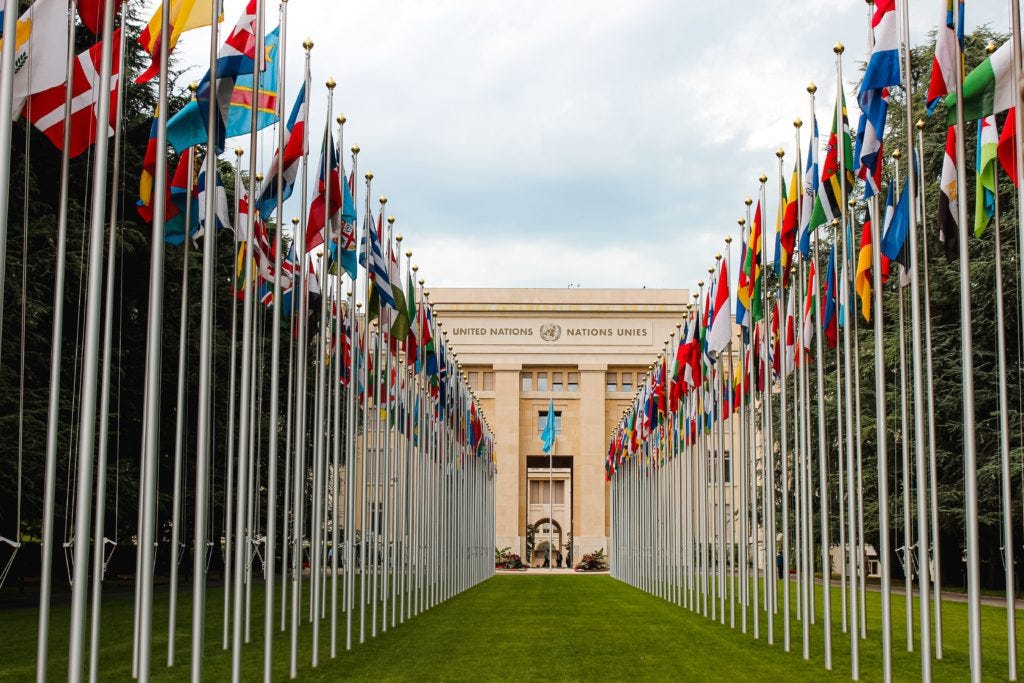
Those who seek to apply international law against American actions are deliberately trying to constrain us from acting in our interests. It is always worth trying to understand what the motivations are for that end goal. For our adversaries, the answer is clear: a weaker, restrained America is one that cannot interfere with their malign objectives. For the Americans who promote international law’s applicability to the domestic context, they are likely well-intentioned progressives or liberals. But they are acting in a functionally anti-American fashion by seeking to throw away our national sovereignty for the whims of others, often our civilizational enemies. International law may sound good to American liberals when it is largely formed by European elites, but that is already increasingly not the case. A Chinese-made international legal order is far less appealing – unless you’re a progressive darling like Twitch streamer Hasan Piker.
The world has changed immeasurably since the concept of international law was cooked up in the universities, salons, and bureaucratic cloisters of early modern Europe. It has changed just as much from the concept’s pre-WWI heyday as a series of gentlemen’s agreements between European empires. Today, we see a return to the Great Power conflict of the 19th and early 20th centuries, but without the shared elite honor culture and broad sociocultural similarities between the nations being bound by those agreed-upon rules. The good faith efforts of our civilizational predecessors have been warped into a parody of themselves. The only nations bound by these rules are those who feel bad about breaking them, allowing the world’s worst actors to carry out their evils unabated, all the while limiting the response of the nations who could counter them. International law was just not built for the world we live in today.
If we want to beat out our geopolitical rivals in the modern iteration of Great Power conflict, we must refuse to implement it in the fashion we are being told to. It must not limit our options in responding to national security challenges, dealing with adversary regimes, or advancing our interests. It must only be enforced if already codified in American law and validated under the constitution. And it absolutely must not be allowed to infringe on the constitutional protections for Americans’ God-given liberties. Only by vocally opposing this infringement on our sovereignty under the guise of international law will we be able to level this aspect of the playing field against our foes. This does not mean that America should act lawlessly; it simply means that we should not judge lawfulness against anything but US law. No longer can we allow our greatest enemies to artificially constrain our behavior on the world stage and unduly affect our internal politics. Enough is enough.
International law is a farce, and we should treat it like one.
I have opined on this issue before, most recently on Episode 15 of the Rational Policy Podcast. We will be talking about the issue writ large again on the upcoming Episode 19 of the show.
This is not to say that all opponents of these strikes fit this bill. Many, mostly on the conservative right, argue against them on the basis of interpretations of American law, separation of powers, or executive authority. I have much more time for those particular arguments, even if I may disagree.
As I explained in my annual Thanksgiving piece, our rights are not granted by government, but are innate to us as human beings.
For reference, there are over 190 recognized nations in the world. The ratifiers of the Rome Statute in 2002 comprised less than a third of the planet’s countries.