

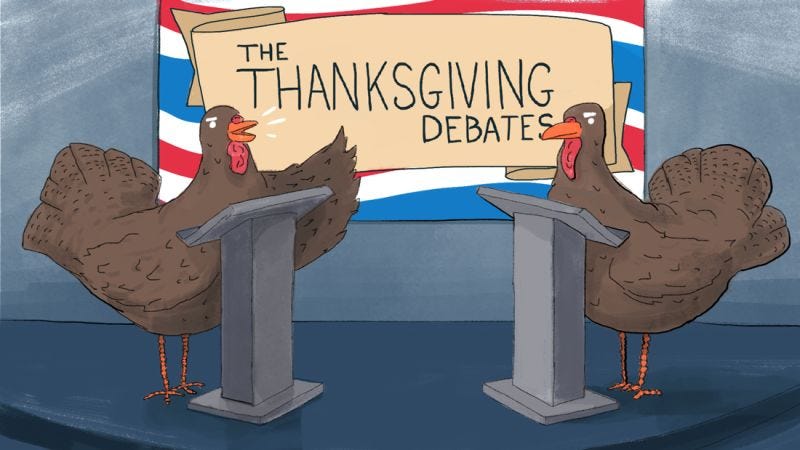
I always try to write down my thoughts each year for Thanksgiving, usually touching on something I’m profoundly grateful for. I’ve written about America’s defense of free speech (2025), the importance of parenthood (2024), the wonders of modernity (2023), and the deeply American nature of the Thanksgiving holiday and of gratitude as a value (2022). This year, I’ve been grateful for a lot, but I’m going to switch it up a bit and try to impart a slightly different message, one that I think we all need to hear: politics isn’t important.
I know that it might sound weird reading a professional political analyst tell you that “politics isn’t important,” but it’s true. Politics – elections, national discourse, legislative fights, the ups-and-downs of the 24-hour news cycle – really doesn’t matter all that much. There are vanishingly few things in American politics in 2026 that are truly life-or-death; even our most difficult and intractable problems are ones that are, in the grand scheme of things, relatively minor. We are not starving to death. We are not killing each other en masse in a brutal civil war. We are not living under the jackboot of totalitarianism. We are, in historical terms, profoundly wealthy and healthy. The society in which we live is exceptionally stable. The decisions made by our leaders aren’t existential. These are all very good things!
And yet we are obsessed with politics, to the detriment of ourselves, our society, and our future. For many, politics has become a substitute not only for religion, but increasingly for most other normal human interaction. For its adherents, it is all-consuming, sucking up all of their time and attention and inflecting every other aspect of life. But this is maladaptive and unnecessary. The country we live in is a great one, the greatest in the history of the world. We live lives of relative ease compared to our forebears and even our contemporaries elsewhere on the planet. Our political system is extremely durable, protects our individual rights and freedoms from government tyranny, and gives us the resources to defend those liberties if they come under fire. Because of that, we are liberated from the idea that our personal politics determines our future.
When politics is actually a salient subject in daily life – in places where it is forced to be due to material deprivation, tyrannical government, or civil war – things are very bad. We should desire banal politics that end up being unimportant, as that lets us focus on the truly meaningful things in life: family, faith, friendship, and fun.
I am grateful to live in a country where who you vote for does not define who you are. It does not define how you relate to your fellow Americans. It does not make or break how you live your life. Americans are blessed in that respect. We can find love, build families, worship how we wish, say what we believe, create a meaningful career, and live in a place we desire among people we choose to live with. We have 50 states, thousands of towns and cities, and innumerable neighborhoods across this amazing land, none of which are exactly alike. America is the land where a thousand flowers can truly bloom. One can find his home here, no matter his politics.
In fact, it used to be considered rude or gauche to even bring up politics at all in casual conversation or at family events; now, it is expected, at least among folks in my generation (Millennials) and younger. One can trace this development back to the Obama administration, during which there was a full-scale push to get Millennials to talk to their family about Obamacare on Thanksgiving, something I’m sure went over just swimmingly in households across the nation. Since then, the politicization of everything has rapidly proliferated, with people cutting off friends, family, or colleagues due to their political views – or, what’s worse, their choice not to share their views publicly or not to care at all. This has been a veritable epidemic for radical partisans on both sides of the aisle, making it so that fewer and fewer people share community or relationships with folks who disagree. Combine that with geographic sorting and you’ve got a recipe for extremely rare cross-partisan conversations. This is a very bad thing.
We do best as humans when we embrace diversity. Not skin color, gender, ethnic difference, personal sexual choices, or other surface-level factors, but actual, real diversity: diversity of thought. Talking to those who have different perspectives and life experiences is how we grow as people. It is how we learn, change, and test our own beliefs. But even more important than talking to others with divergent views is listening to them. It is very hard to create a strawman caricature of someone on the other ‘side’ of politics when you can put a real face, name, and voice to that image. When that person is your neighbor who helped shovel your driveway or whose kids play basketball down the street, they cannot be made into a political pinata for convenient destruction.
People always want to know who you voted for. Far more important, though, is how you treat those who voted differently. Do you think of them as the enemy? Or as people who may think differently or might just be wrong? We are all Americans, regardless of who we voted for or what we believe about politics. We have families, careers, hobbies, hopes, fears, and dreams. We want the best for our country and our loved ones. We may differ on how to get there, but are those differences worth hating each other over? Absolutely not.
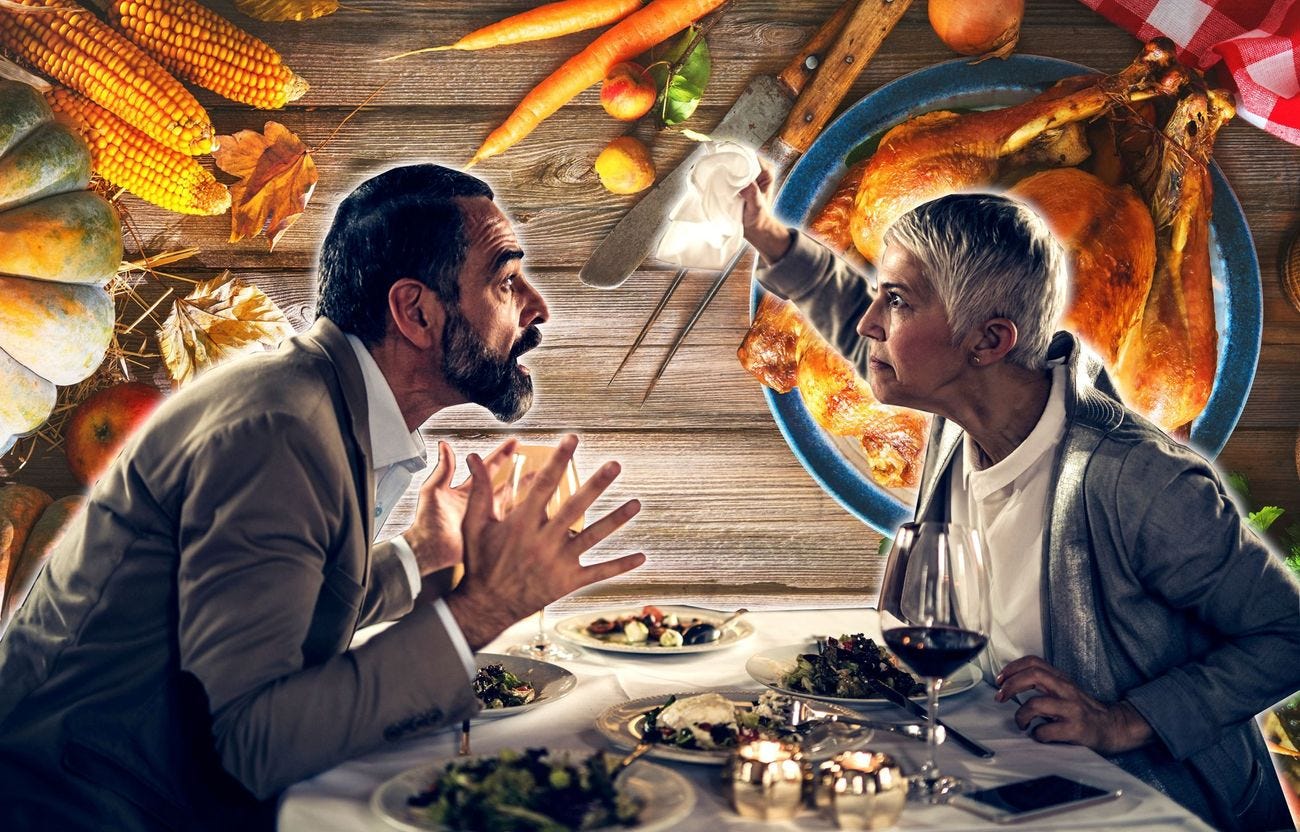
So, this Thanksgiving, drop the politics. Focus on what really matters in life, the things we share as Americans: our families, our friends, our traditions, and our love for our country. And if you just can’t help but start an argument with your uncle over turkey dinner, at least be normal and make it about football.
Happy Thanksgiving and may God bless the United States of America.