

As has been the case for months now, the war in Iran is in a state of flux. The future is uncertain, but not because the Iranians are hiding the ball – the malign conduct of the regime in Tehran is perhaps the lone constant here. The approach of the Trump administration, however, has been the antithesis of constancy, led by the principal himself. We have repeatedly vacillated between combat and conciliation, and this week is no different. (Still, there is another way.) But there are broader issues in play here besides the day-to-day rigamarole of the news cycle, ones that are far more interesting. As I wrote last week, the Strait of Hormuz is one such issue. Not only does it have global implications, it has often been misleadingly portrayed by critics of the conflict, used as a trope to shut down any sort of hawkish argument. Rebutting those inaccurate claims is incredibly important if we are to actually understand what is happening in this conflict.
And that brings us to what you are reading right now. Because another faulty trope meant to shut down hawkish perspectives has fully arrived on the scene: the “war crime” accusation. This one has been floating around in the online ether for quite some time, but the past few days have seen a resurgence in its use, centered around the idea that the US may choose to strike infrastructure targets, including power plants, in future rounds of combat with Iran. These were not targeted in the first major round of fighting in March, but have remained an option for escalation ever since, one that the president has not been shy about invoking. Opponents of these strikes and of the fight against the Iranian regime overall have preemptively labeled them war crimes, stating that any attack on infrastructure that can plausibly have a civilian purpose is illegal under international and US law. They say this with an overwhelming confidence and declare anyone who contests this characterization as supporting the most egregious violations of morality and decency.
For a case in point, see Curt Mills, the executive director of the extraordinarily inaptly-named American Conservative magazine. In the embedded tweet below, he directly states that Rebeccah Heinrichs (an excellent defense commentator and follow on Twitter/X) is advocating for the commission of “war crimes” because she suggested that strikes on Iran’s energy infrastructure could be effective.


When confronted with the idea that his post was completely inaccurate, he doubled down, gaining the support of fellow travelers on the left like the antisemitic, anti-American Islamist propagandist Mehdi Hasan:

So, is it “literally a war crime” to target enemy energy infrastructure? The answer is extremely simple: no.
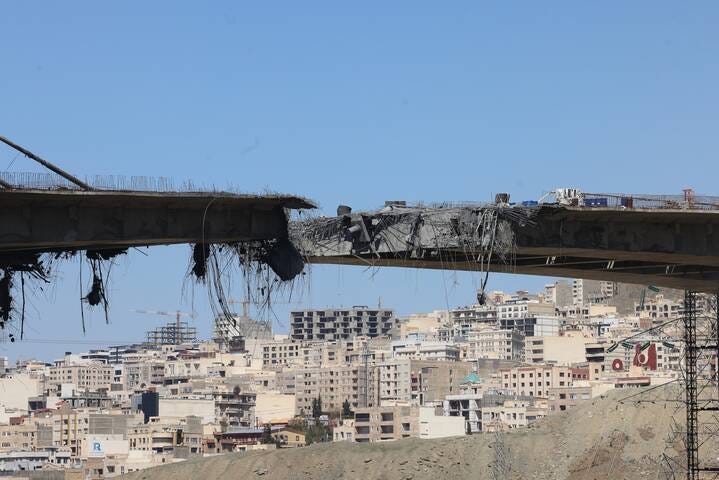
Attacking energy infrastructure, including power plants and oil facilities, is not a presumptive war crime. Neither, for that matter, is attacking communications systems or transportation infrastructure like ports, bridges, railways, or airports. Although these enemy assets often have civilian purposes, that does not preclude them from serving military aims as well. These dual-use targets are fair game in war, as they can harm the enemy militarily and serve a genuine martial purpose, even if they are primarily or normally civilian in nature.
Don’t believe me? You don’t have to. This is all spelled out in both international and American military law, and is backed by longstanding historical precedent.

Let’s start with the most common appeal to authority that these critics make: that of international law. The governing legal framework on this issue are the Geneva Conventions of 1949, particularly the first Additional Protocol, agreed in 1977. Paragraph 2 in Article 52 of that international treaty reads as follows:
“2. Attacks shall be limited strictly to military objectives. In so far as objects are concerned, military objectives are limited to those objects which by their nature, location, purpose or use make an effective contribution to military action and whose total or partial destruction, capture or neutralization, in the circumstances ruling at the time, offers a definite military advantage.”
As one can see, this section does not prohibit targeting of infrastructure used by both civilian and military customers, as long as the attack “offers a definite military advantage” and the target makes “an effective contribution to military action.” Power plants, oil export facilities, bridges, railways, and ports all fall into the realm of legitimate targets under this rubric. There is no blanket immunity here for ostensibly or partially civilian targets; as long as they are meaningful for the enemy militarily, they can be destroyed.
American legal documentation is even clearer on this front. The Department of Defense/War’s Law of War Manual is the controlling framework for American military personnel on the legality of targeting decisions and it could not be more in line with the idea that targeting dual-use infrastructure is not a war crime.1 In fact, the manual specifically fleshes out each and every aspect of the Geneva Conventions framework, adding context and providing clarity on what sorts of actions would be allowed under the law. For instance, in subsection 5.6.6.2, the criteria for what makes “an effective contribution to military action” are defined in detail:
“The object must make or be intended to make an effective contribution to military action; however, this contribution need not be ‘direct’ or ‘proximate.’ For example, an object might make an effective, but remote, contribution to the enemy’s military action and nonetheless meet this aspect of the definition. Similarly, an object might be geographically distant from most of the fighting and nonetheless satisfy this element. Military action has a broad meaning and is understood to mean the general prosecution of the war. It is not necessary that the object provide immediate tactical or operational gains or that the object make an effective contribution to a specific military operation. Rather, the object’s effective contribution to the war-fighting or war-sustaining capability of an opposing force is sufficient.”
This detail provides a very clear window into the exceptionally careful thought process behind military decisions, including why objects that might seem uninvolved with warfighting can still be legitimate targets. Anything that can be used by the enemy to sustain its ability to prosecute the war or bolster the warfighting ability of the enemy can plausibly be targeted while still falling within the framework established by the Geneva Conventions and delineated by the US military. The manual goes even further, expanding on the idea of “definite military advantage” and explaining how that advantage may not be immediately and publicly visible:
“The advantage need not be immediate. For example, the military advantage in the attack of an individual bridge may not be seen immediately (particularly if, at the time of the attack, there is no military traffic in the area), but can be established by the overall effort to isolate enemy military forces on the battlefield through the destruction of bridges. ‘Military advantage’ refers to the advantage anticipated from an attack when considered as a whole, and not only from its isolated or particular parts. Similarly, ‘military advantage’ is not restricted to immediate tactical gains, but may be assessed in the full context of the war strategy. The definite military advantage offered by damaging, destroying, or neutralizing the object may result from denying the enemy the ability to use this object in its military operations (i.e., to benefit from the object’s effective contribution to the military action). For example, the attack or seizure of objects with a common military purpose, such as bridges used, or potentially available to be used, in lines of communication would offer a definite military advantage. The military advantage from an attack is not limited to denying the enemy the benefit of that object’s contribution to its military action. For example, in a diversionary attack, the military advantage to be gained from attacking an object would result from diverting enemy forces’ resources and attention. The military advantage from an attack may involve a variety of other considerations, including improving the security of the attacking force. The military advantage from an attack may result from harm to the morale of enemy forces. Diminishing the morale of the civilian population and their support for the war effort does not provide a definite military advantage. However, attacks that are otherwise lawful are not rendered unlawful if they happen to result in diminished civilian morale. The military advantage expected to be gained from an attack might not be readily apparent to the enemy or to outside observers because, for example, the expected military advantage might depend on the commander’s strategy or assessments of classified information.”
This is a capacious definition of “military advantage,” but one entirely in line with history and international law. Contra the claims of the critics, kinetic action need not be focused exclusively on enemy bases, military assets, or munitions depots to be lawful. This fairly exhaustive level of detail proves that much quite easily.
But if that isn’t enough, we can go just a bit further down into the manual to subsection 5.6.8, which directly lays out some key examples of potential dual-use objects that would be properly characterized as military targets in war. These include leadership facilities, communications systems, transportation infrastructure, militarily significant geographical features, and, most importantly for our purposes, “economic objects associated with military operations.” This passage is worth quoting directly, with no additional comment required:
“Economic objects associated with military operations or with war-supporting or war-sustaining industries have been regarded as military objectives. Electric power stations are generally recognized to be of sufficient importance to a State’s capacity to meet its wartime needs of communication, transport, and industry so as usually to qualify as military objectives during armed conflicts. Oil refining and distribution facilities and objects associated with petroleum, oil, and lubricant products (including production, transportation, storage, and distribution facilities) have also been regarded as military objectives.”
The evidence is crystal clear that targeting dual-use infrastructure, including power plants and bridges, does not a “war crime” make. In fact, the benefit of the doubt largely rests with the attacking military, as the definitions involved are relatively comprehensive and far-reaching. But what about the history? Has the US targeted these sorts of facilities in the post-WWII era, particularly after the ratification of the Additional Protocol to the Geneva Conventions in the late 1970s? The answer is a resounding yes.
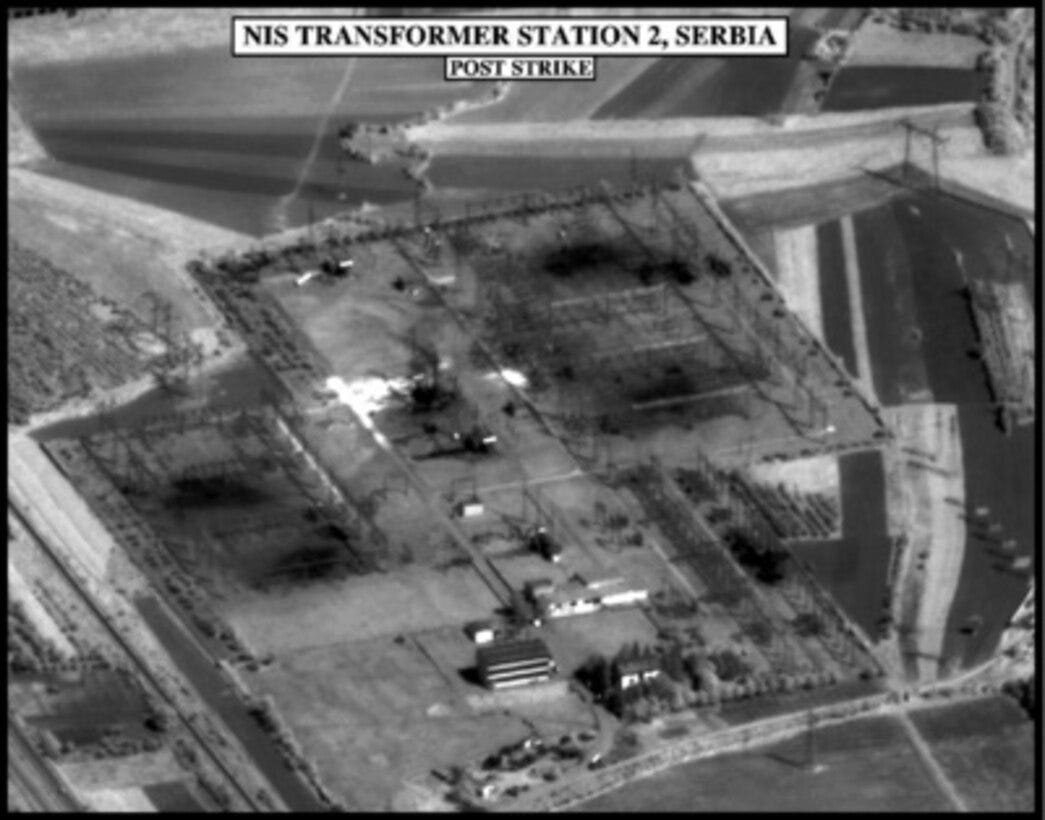
American forces have repeatedly and devastatingly targeted power stations, electric grids, and oil facilities in the past, most notably twice during the otherwise-calm 1990s. During the Gulf War in 1991, American aircraft largely destroyed Iraq’s power generation and supply capabilities, flying hundreds of sorties and degrading nearly 90% of the country’s energy grid and generation capacity in the process. This was justified under the idea that said capacity was crucial in helping the Iraqi military fight back against American forces, whether by powering their command-and-control networks, operating their military communications system, or supplying bases used to muster forces. The US, alongside NATO, went back to this well in 1999 in the Kosovo conflict, striking Serbian energy infrastructure under the dual-use framework. Strikes were targeted at power plants, transmissions systems, oil facilities, and bridges, many of which were totally destroyed. Again, the framework detailed above was used to justify these actions. In both cases, civilians were impacted; power outages and other hardships were commonplace in Iraq and Serbia during the combat, affecting ordinary citizens as well as military readiness. Yet this, as we have learned, does not transform an otherwise lawful strike into a war crime.
Not only is striking enemy dual-use infrastructure allowed under both American and international legal frameworks, it is a fairly common occurrence when fighting against an enemy with a significant level of state capacity (i.e. not a non-state actor or terrorist group). When it comes to Iran, the case is just as solid, if not even more so. The potential targets very clearly serve a military purpose, but many are also wholly owned and controlled by the Islamic Revolutionary Guards Corps (IRGC) itself, making their targeting essentially non-controversial in terms of the law.
So why are so many critics so gung-ho about labeling legal strikes as “war crimes?” The answer to that question lies a few years in the past. So, if you will indulge me, let’s take a trip to October 2023. Obviously, we all remember that time for the Hamas attack on October 7 – the largest massacre of Jews since the Holocaust – but these people likely remember it for something else: the hard launch of the “genocide” allegation against Israel. The “genocide” claimers did not even wait until the bodies of October 7 were cold before accusing the world’s lone Jewish state – once again, the victim of the barbaric violence in question – of this most egregious crime against humanity. This claim is incredibly spurious, as I explained in the pages of National Review all the way back in October of 2023, as it ignores the clear, widely-agreed definition of the term “genocide” as laid out in international law in favor of a novel invented meaning that can be stretched to include basic Israeli warfighting. They have a predetermined conclusion – that Israel committed genocide – and are willing to do anything to warp reality and pretend that conclusion is true.
Still, the smear has stuck. So much so that progressive politicians like Alexandria Ocasio-Cortez, Rashida Tlaib, Ilhan Omar, Bernie Sanders, and Zohran Mamdani have called the “genocide” “ongoing,” even after the cessation of major hostilities over a year ago. Israelis and their supporters are still labeled “genocidaires,” threats to arrest Israeli prime minister Benjamin Netanyahu remain live, and the ridiculous and insulting idea that Israel indiscriminately or deliberately murdered women and children will not die. In short, they’re operating entirely on vibes, not facts – and it’s working.
And that is exactly why the “war crime” smear is being trotted out in force today, often by the same exact people. They saw the viral success of the “genocide” libel against Israel and are attempting to use an identical playbook against the US in Iran. There is no remotely plausible case for “genocide” in Iran, so they’re defaulting to the next worst thing: “war crimes.” But the approach is the same. They ignore reality, warp definitions, disregard the clear text and meaning of international and American law, and do so with the immense self-confidence of a champion prizefighter who describes himself in the third person. But in reality, they’re not Mike Tyson; they’re Glass Joe. Their slander here is so patently absurd that it barely merits laughter, much less several thousand words in rebuttal. Unfortunately, the same was true for the “genocide” smear and look where we are now.
So yes, the allegation of “war crimes” in Iran is the new version of the anti-Israel “genocide” blood libel. It is a phony claim, backed with no evidence, based on evident lies about the relevant legal framework and relying for its success on the gullibility of the audience and the forcefulness with which the lie is delivered. At root, the whole purpose of both allegations is to undermine the West’s moral legitimacy against the patent evils perpetrated by our enemies, forging a false equivalence and flipping reality on its head. We must not allow that to happen. The “genocide” blatherskite has sadly been successful; let’s make sure that the equally-absurd “war crime” nonsense meets a very different end.
To be clear, this manual is not a Trump administration document. The current version was originally published under the Obama administration and was most recently revised under President Biden in 2023.
Great article. One question though: at what hypothetical point would strikes on civilian targets (as say, Russia is doing to Ukrainian civilian infrastructure) tip over into a war crime?