

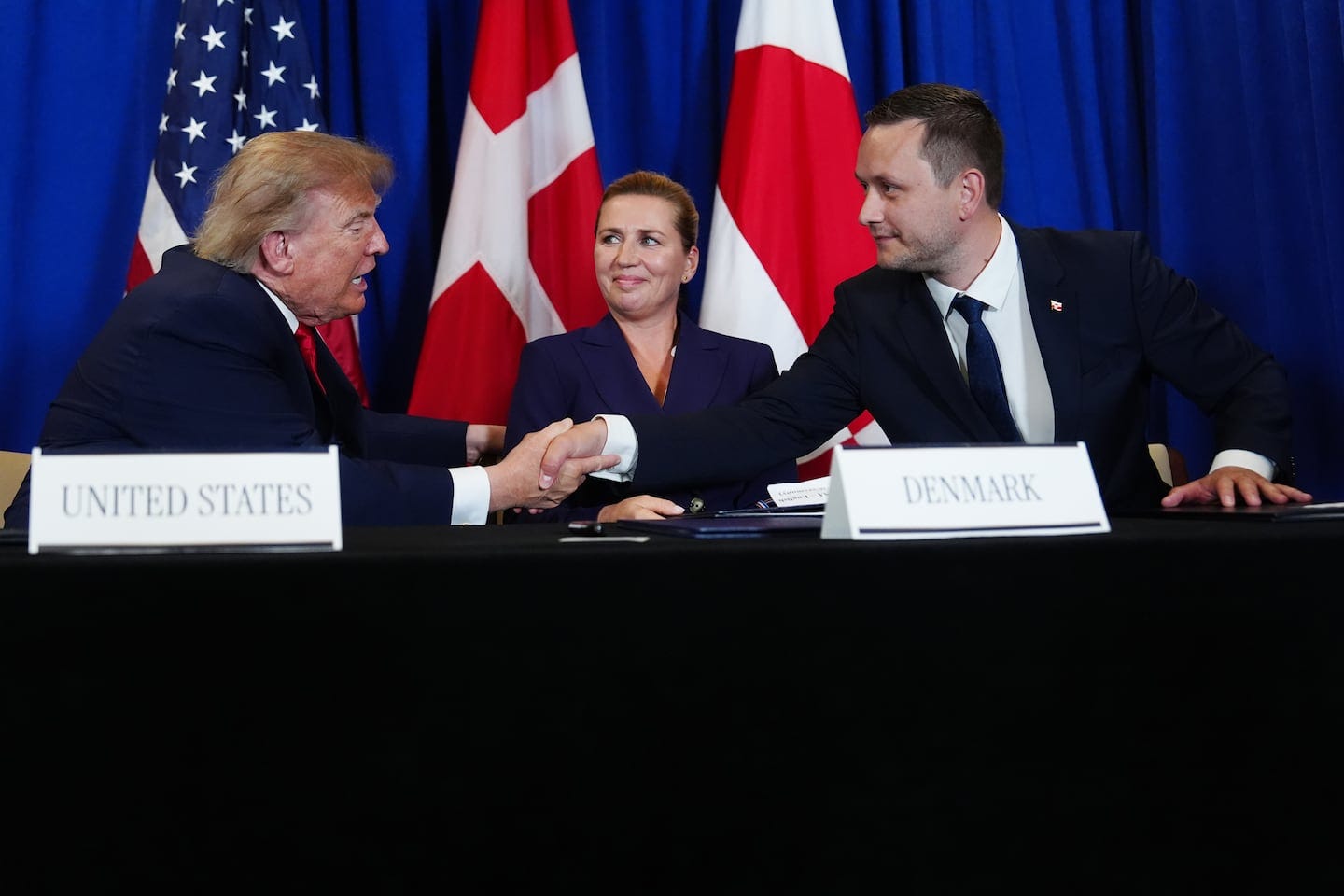
I am once again quite excited to be back in the pages of The Dispatch, this time delving into an issue that I have become something of an expert on: Greenland. In the piece, I argue that the new deal struck between Copenhagen, Washington, and Nuuk is a good one that repairs a lot of the issues inherent in the prior 1951 agreement, including removing it from the NATO orbit, centering American homeland and hemispheric defense concerns, granting the US broader basing, transit, and military rights, and giving us a permanent and total veto on any non-NATO presence on Greenland. That last item is the real victory here, as it allows us to ensure that no Chinese project gets approved on the island without our say-so; given China’s history of weaponizing dual-use projects for gray zone warfare, this is a major win. I also aver that the deal itself could have been struck in a friendlier manner far sooner, but that the counterproductive bluster of the president did not derail it, nor permanently damage trilateral relations.
Below is an excerpt, but you can read the whole thing here.
Unfortunately, our Danish and Greenlandic friends are ill-equipped to deal with these new geopolitical challenges and opportunities. But the United States is. Neither Denmark nor Greenland has a direct interest in maximizing the hemispheric defense potential of this Arctic landmass. But America does. The Danes and Greenlanders may wish to better secure the territory, but only the U.S. has the ability to do so. America has a population 57 times larger than that of Denmark, lies much closer to Greenland geographically (about 1,200 miles versus approximately 1,800 miles), and spends more on defense in a week than Denmark does in a year. Greenland’s population would make it only the sixth-largest city in Idaho, but it is tasked with controlling a territory three times the size of Texas—the mismatch is obvious. Washington, however, is well-equipped to handle the defense of Greenland, particularly against the gray-zone warfare commonly used by our adversaries, as well as maximize its utility as a bulwark for hemispheric and homeland security.
The problem we face is that the long-term structure of the trilateral U.S.-Denmark-Greenland security relationship was ill-suited to the challenges posed by our modern adversaries. The 1951 agreement that governed our current security relationship was built for an entirely different world. That deal foreground Danish sovereignty and granted America rights only at the sufferance of Denmark. It said nothing about American homeland defense, nothing about economic rights or sensitive dual-use sectors, and nothing about what would happen to the agreement if the NATO status of any signatories fundamentally changed. Given the rapidly changing threat picture, the salience of Greenland to U.S. homeland defense, and the importance of maintaining a Greenland free of malign foreign influence in accordance with U.S. interests, the existing arrangement needed updating. And that is exactly what this new deal achieves.
Denmark did not sell us Greenland. It did not give up its sovereignty over the land. America did not invade the island militarily, nor did we make it the 51st state. All of that was unfortunate bluster, mostly from the president himself. But what we did achieve was perhaps more meaningful and certainly less costly than a purchase and annexation would be. This new deal, the text of which was released last week by the White House, gains us significant new advantages and rights. It certainly is not a mere repeat of the 1951 agreement and includes many necessary updates to help secure Greenland and U.S. interests well into the 21st century.
One of the most important changes in this new agreement was to make it permanent and separate it from the related NATO treaties that were initially incorporated into the 1951 agreement. The prior agreement lasted “for the duration of the North Atlantic Treaty,” tying America’s ability to pursue its own security needs in Greenland to the existence of NATO. The new deal remains operative even in the case of Greenlandic independence, a party leaving NATO, or the end of the Atlantic alliance altogether. Ideally, NATO will remain intact in perpetuity, but planning for contingencies is highly useful, particularly when it comes to such a vital security interest.
Similarly, removing the idea that this agreement was part and parcel of the parties’ NATO responsibilities allows for a greater focus on specific American security interests that may not fall directly under the aegis of the Atlantic alliance. The security of the American homeland is not directly mentioned in the 1951 treaty, only obliquely referenced. The focus is instead on collective security for NATO members and the implementation of “NATO plans” as agreed by the whole of the alliance. The new deal explicitly foregrounds the security needs of “the American continent,” putting it on equal footing with the direct security of Greenland as well as the aforementioned North Atlantic Treaty area. This is a meaningful alteration that preserves for Washington the right to act in our own domestic and hemispheric security interests, without any reference to joint NATO decision-making or planning. Increasing our sovereign ability to act unilaterally in our own interests to protect the homeland is a major step forward that helps solve many of the potential issues inherent in the older agreement.
On top of that, America’s freedom of action has been improved in other ways. The U.S. can, by right, establish and control two renewed defense areas without additional consultation with local or Danish authorities. We are able to establish future defense areas ourselves, only interfacing with the Danes and Greenlanders on implementation. We have slightly greater freedom of movement for personnel, weapons systems, military vehicles, and materiel than we did under the prior deal, and we’ve also gained undersea transit rights—a must for Arctic security going forward. In multiple instances in the new deal, the word “shall” replaces the word “may,” which might seem like a minor change, but does in fact grant us the ability to do things by right that may have required advance consultations in the past. Other useful changes include the incorporation of unmanned systems in the treaty, the direct inclusion of the planned “Golden Dome” domestic missile shield project, and language dealing with counterespionage cooperation. These are all meant to bring our defense situation in Greenland up to date and modernize the controlling language in the agreements so as to embrace technological change and account for the basic shifts in the threat picture both toward Greenland and the American homeland.
Finally, and certainly most important, the new deal plainly excludes America’s biggest rivals, notably Russia and China, from establishing any sort of meaningful Greenlandic presence, whether military or economic. This is the biggest win in the agreement for the U.S. and was, according to the adminstration, the primary reason for seeking to alter the status quo. Still, some may suggest that directly prohibiting non-NATO bases or investment in strategic economic sectors—a term this agreement defines fairly broadly—is unnecessary given that it has not happened yet and, in the minds of these critics, would not happen in the future. It seems quite obvious that Russian involvement in Greenland would be a non-starter in Copenhagen, but Beijing is a different animal entirely, especially when it comes to economic power. China has successfully pressured nations far stronger and more populous than Denmark and Greenland, it has used investment in strategic sectors to gain inordinate influence and forward CCP ends, and it often camouflages nefarious intent behind ostensibly neutral activity. This deal presumes to exclude outside influence, requiring active agreement between all parties that the proposal in question does not “constitute a threat to national security or public order.” This is tantamount to a total exclusion of nations like China from any meaningful role in Greenland in perpetuity. Ensuring that Washington has this permanent veto over any Chinese involvement in Greenland is an enormous win for American homeland defense.
People on both sides of the Atlantic lost their ever loving minds over Greenland. I'm glad all sides were able to come to an agreement once all the bluster died down.