

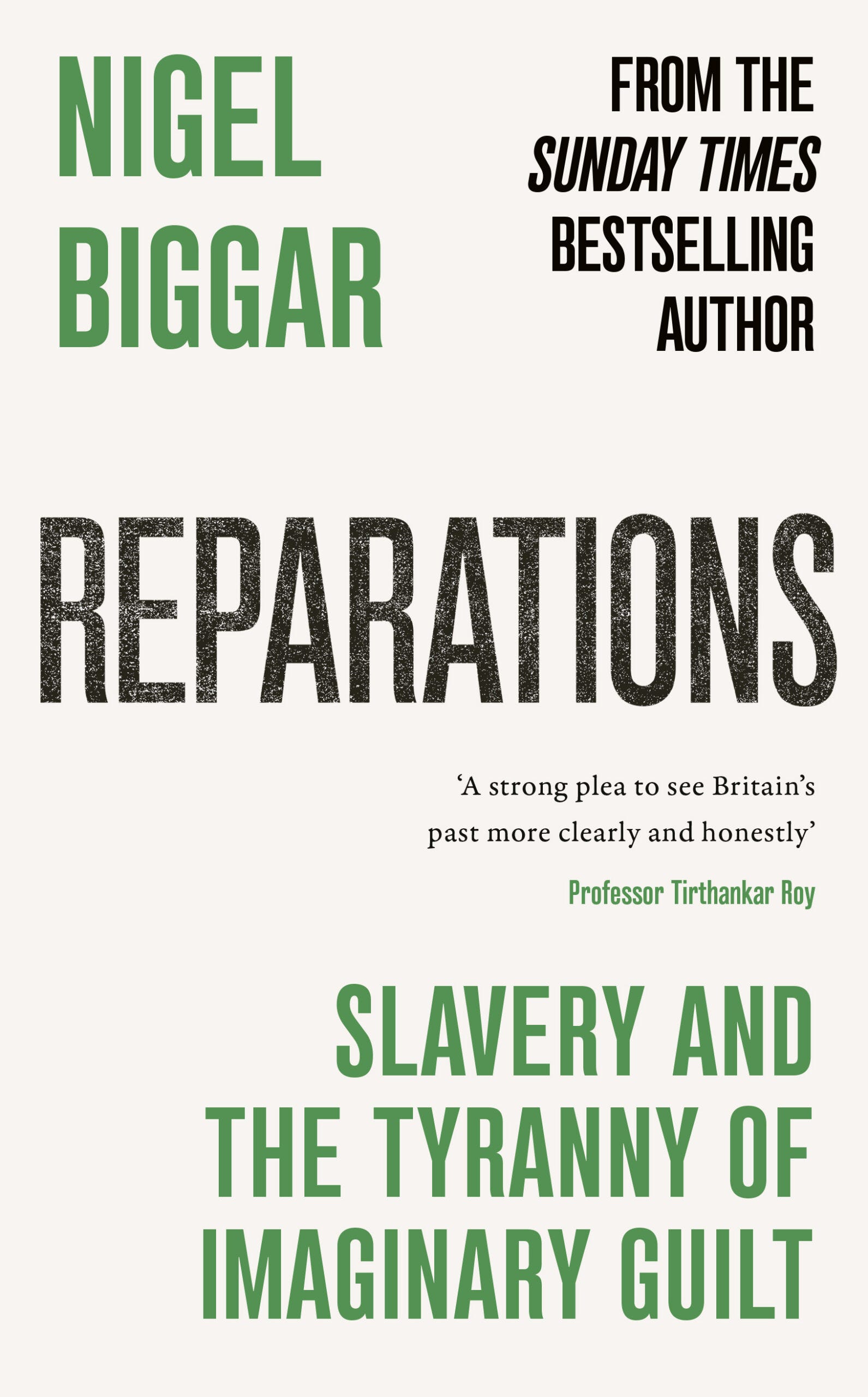
My work has returned to the digital pages of Providence Magazine once again, this time with a review of Nigel Biggar’s 2025 book Reparations: Slavery and the Tyranny of Imaginary Guilt. The reparations debate may seem like ancient history here in the US, peaking in the George Floyd moment of 2020-21, but it is alive and well overseas, especially targeting the former British Empire. The United Kingdom has been inundated with claims that it is responsible for all the evils of the transatlantic slave trade - now considered by the UN to be history’s greatest crime, absurd as that sounds to anyone who knows history - as well as the poor economic development of former slave-centric colonies in Africa and the Caribbean. But this couldn’t be further from the truth. And Biggar’s book does yeoman’s work explaining why, all backed by concrete evidence. It’s a masterclass that is well worth the read, particularly so given its brevity.
Below is an excerpt of my review, but you can read the whole thing here.
The early chapters of Reparations describe the actual history and context behind the transatlantic slave trade, Britain’s involvement in enslavement and, more importantly, abolition, and the complex post-abolition economic histories of the reparations-seeking nations. All of the facts, figures, and analyses that Biggar musters in this section form the real meat of the book and serve as ready-made counters to many of the most commonplace pro-reparations arguments. He explores the broader historical phenomenon of slavery, bringing to bear plenty of evidence that shows it to be a sadly-universal institution across cultures and epochs, certainly not one particular to the empires of Western Europe, even when it comes to trafficking in Africans. The most enlightening examples presented to bolster this point are ones that reparations activists intentionally ignore.
One such counterpoint is the existence of the Arab slave trade, which lasted for centuries longer and probably trafficked far more Africans than did Europeans (though precise counting is impossible for long-term historical phenomena like this), only ceasing when threatened with the British Empire’s military and economic might. Another is the complicity of Africans themselves in the capture, trade, and exploitation of slaves – a controversial claim, but one that is heavily supported by the primary sources. Biggar assembles a great deal of this proof, showing how the arrival of European slavers merely provided a new and profitable market for a pre-existing trade, as well as how many African rulers and societies fought against abolition. This context serves as exculpatory evidence against the claim that Britain’s involvement in the slave trade was uniquely pernicious.
Britain did have a unique role in the history of the global slave trade, however: ending it. This is the context most commonly and cynically shorn from the pro-reparations narrative, and understandably so: Britain’s abolitionism was far more important and historically unique than was its role in enslavement. Biggar does yeoman’s work bringing to bear significant support for this position, detailing how Britain was at the very forefront of the abolition movement, driving the cessation of the global slave trade even at significant economic and geopolitical cost to the empire.
When Parliament ended the slave trade in 1807, London’s strategic fortunes were at a low ebb; Napoleonic France was in control of the majority of the Continent and was about to attempt to cut off all British trade to Europe, making the slave-centric colonies all the more crucial. And yet London voted to fight its greatest foe with the equivalent of one hand tied behind its back, handicapping itself economically and even dispatching its wartime navy to suppress the trade. That the full emancipation of slaves across the empire took another three decades and was done in an incremental and conservative fashion, including by compensating slaveowners and creating a brief post-slavery apprenticeship program, does not undercut the fact that emancipation came early and was successful. It also does not change the reality that it was British thinkers, politicians, and theologians who led the charge in fighting for abolition worldwide, against the societal and civilizational currents that had been present for thousands of years.
But Britain did not stop in the 1830s when it freed the slaves living under the empire; it spent the next several decades going around the world to halt both the slave trade and slavery as an institution, by force of arms if necessary. This moral crusade, fondly remembered by the contemporary British statesman Lord Palmerston as “the achievement which I look back on with the greatest and purest pleasure,” was historically exceptional and extraordinarily costly. Britain’s immense naval might was marshaled in service of this noble aim – during the mid-1800s, up to 13% of its global fleet was stationed off West Africa for this purpose alone – and was regularly used to interdict ships, blockade ports, and even attack coastal fortresses. The empire also utilized its skilled soldiers and experienced bureaucratic corps to end this evil practice worldwide. Abolition was centered in all of the empire’s diplomatic overtures to slaving polities, even when it created problems for other core British interests, while several new colonies, mostly unprofitable, were established so as to enforce local emancipation.
The economic cost of these impressive and dedicated efforts was not small. Expert estimates put the present-day cost of suppressing the transatlantic trade alone at between £1.4-1.7 billion per year for half a century, in an era when government spending was a minuscule fraction of what it is today. Other economic historians taking a broader view estimate that the full cost of British anti-slavery efforts, including price impacts, direct costs, and loss of business, amounted to 1.8% of national income from 1808 to 1867, a figure which nearly matches total modern-day UK defense spending. That this amount was spent on a purely moral and ideological project across 50-plus years is a major argument against the reparations narrative. It is no wonder they studiously avoid it.