

The first year of the second Trump administration has been, in a word, chaotic. When it comes to foreign affairs, that disorder has been even more pronounced. Some of their actions have been good, others bad. That is normal for any presidency, but the extreme peaks and troughs inherent in Trump himself exacerbate everything. The most recent example of this heightened chaos on the international scene revolves around the question of Greenland. I have written and spoken extensively on this subject, including over at The Spectator and Providence. In short, I am a proponent of greater US control of the semi-autonomous Danish island, but a staunch opponent of the president’s mafioso tactics along the way. But that is beside the point.
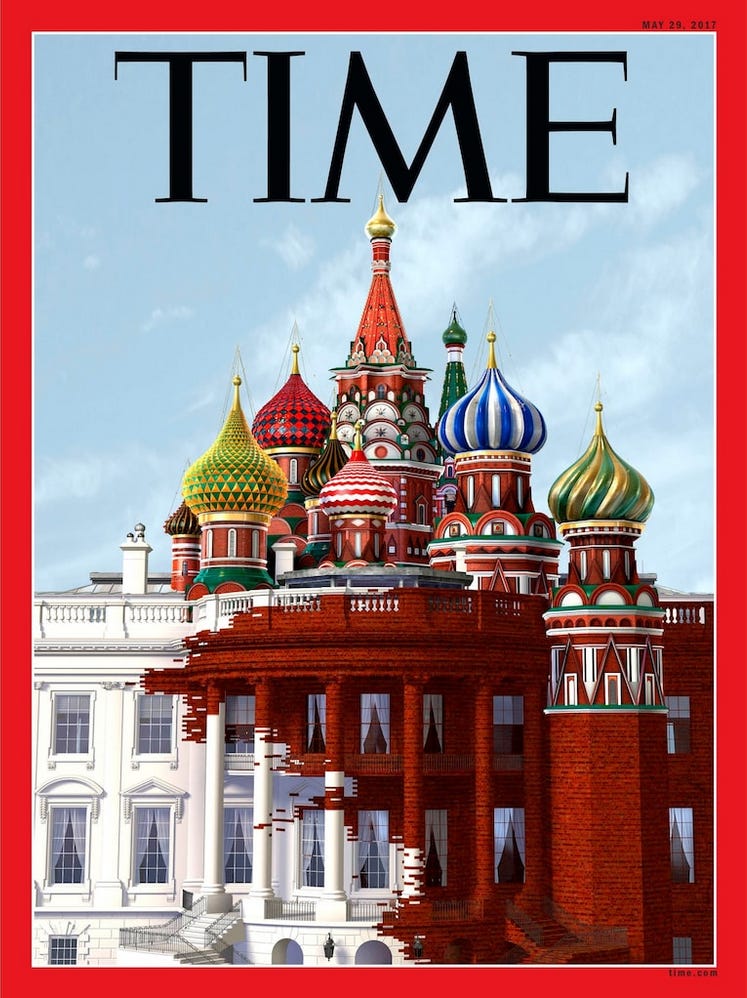
The reason I bring up Greenland is that the situation has rapidly spiraled into a burgeoning transatlantic crisis, with European allies up in arms – at least somewhat reasonably – threating mutual tariffs and an embrace of China in retaliation. This has been heralded by many opponents of the president as the final nail in the NATO coffin, saying that it is exactly what Moscow desires.1 Some critics have gone even farther, calling President Trump “a Russian asset.” This is not a new charge. Infamously, it was widely bandied about during the first term, sparking multiple investigations, years of frenetic #Resistance discussion about “the walls closing in,” and even a Time magazine cover depicting Russian onion domes over the White House. The refrain was a constant theme of the first three years of Trump’s tenure, finding its way into every news cycle, regardless of how farfetched the story. We had the pee tape, the kompromat, the Alfa Bank server, the supposed quid pro quos, the claimed changing of votes from Moscow, the Cambridge Analytica saga, and more. The piece de #Resistance, if you will, was the allegation – delivered in all sincerity – that Donald Trump had been cultivated as a Russian intelligence and influence asset since the 1980s.2
That hysteria seems so old partly because it is: the panic began a decade ago. It is decidedly of a pre-pandemic world, feeling especially outdated because of that. And yet here it is. It is the lie that won’t die. But it certainly deserves to.
Do Trump’s opponents not remember the lather they worked themselves into for three straight years over this issue? Do they not remember the breathless MSNBC segments, the ridiculous CNN chyrons, or the (mostly debunked) Pulitzer Prize reporting covering every angle of this story? Do they not remember the congressional hearings, the miniature cannon firings, the document leaks, or the plethora of podcasts this whole thing spawned? Do they not remember the years-long independent federal investigation of this entire matter, carried out by an unimpeachable former FBI director who they fetishized? You know, the guy they put on prayer candles, soda bottles, vaguely homoerotic children’s books, and jewelry? The one who they lauded as a Hero of The Republic™ for his brave stance against the evil Drumpf……until his thorough, nonpartisan investigation turned up absolutely no proof of collusion between the Trump campaign and Russia, proving that the president was not actually an active agent of influence for Moscow? That guy? Some of us remember all of this nonsense, as we were born before 2008.
This spurious line of attack was conclusively debunked, but it refuses to go away. Hardcore anti-Trump partisans remain attached to this idea as though they are barnacles stuck on the hull of an abandoned ship. To prove their case, they posit a question: if Donald Trump were a Russian asset, what would he be doing differently? Honestly, a lot!

If Donald Trump were a Russian asset, he would not have destroyed the nuclear program of one of Moscow’s critical allies. He would not have authorized an operation to decapitate the Venezuelan regime and exfiltrate Nicolas Maduro. He would not have given Ukraine any weapons whatsoever and would have already imposed a Putin-fluffing “peace” on Kyiv.3 He would not be seizing Russian-linked, sanctions-evading, tanker ships on the high seas almost every day.4 He would not have, in his first term, allowed American soldiers to kill hundreds of their Russian counterparts during a battle in Syria. He would not be trying to displace Russia as the military hardware supplier to dozens of countries across the world. He would not be levying the most severe sanctions against Russian energy seen this century. He would not be pushing to sell American energy to Europe, displacing Moscow as a supplier. He would not have opposed the NordStream2 pipeline. And that is just a start.
That the two Trump administrations have taken these actions and positions completely defeats the Russian asset smear. But it does not excuse some truly awful policy choices and rhetoric from the White House. Donald Trump is far too friendly to all dictators, but he is near-obsequious when it comes to Vladimir Putin. He is antagonistic to Ukraine, uncritically repeats Russian talking points about the war, and seems genuinely to dislike our European allies. He is skeptical of NATO, acts like a belligerent jerk to our closest friends (who just so happen to also be Russia’s biggest foes), and seems all too willing to buy Moscow’s absurd line about mutual economic benefits if sanctions are removed. He has appointed several pro-Russia individuals to key roles in the foreign policy, intelligence, and defense spheres – it’s not just Tulsi Gabbard, folks. Some of these people genuinely believe that America and Russia are natural allies and that we should alter our bilateral relationship to achieve that end, at the expense of Europe.
None of this is good! It all advances the interests of Moscow, while undermining our own. That is disastrous policy which will make us less safe in the future. It is indefensible, corrupt, and morally wrong. He should be excoriated for it and Congress should hold his administration accountable for their failures on this issue. In cases like the war in Ukraine or the importance of our NATO relationships, Congress should go farther, explicitly passing legislation to force a legislative role in approving any Ukraine “peace” plan or change in the NATO status quo. Trump’s dalliance with Russia is bad for America. This is quite plainly obvious to anyone who chooses to look with an objective eye.
See? How hard was that?
It is eminently possible to harshly, if not vitriolically, criticize the president for his views on Russia without hyperbolizing to the point of insanity. Trump need not be a Russian asset to be a useful idiot. He need not take orders from Moscow center to make choices that they would approve of. He is perfectly capable of making supremely bad decisions on his own, as we have seen over and over again for a decade now. Something does not need to be the WORST THING EVER TO HAPPEN TO ALL HUMANKIND to be bad.
Trump isn’t a Russian asset. He’s just a buffoon with spectacularly poor judgment. And that’s plenty bad enough.
I think the death of NATO has been greatly exaggerated, even if it is less strong than it should be at the present moment.
The term “________ asset” is a technical and specific one. It means that the person in question is an active agent of a foreign power, not merely a useful idiot for their cause. Think Aldrich Ames or the Cambridge Five, not Jane Fonda. One cannot be an unwitting asset; this is a mutual, acknowledged, direct relationship. Just doing things that help a foreign power, no matter how inexplicable, does not an “asset” make.
I have many, many, many problems with the Trump administration’s Ukraine policy, but they are not truly giving Russia what it wants, which is what an actual Russian asset would do.
This is great policy, and pretty much exactly what I argued for in an essay for Providence in December.