

I’m once again back in the pages of National Review, this time with an essay covering an important medium- and long-term plan to reduce Iranian leverage over the Strait of Hormuz: the expansion of the regional energy pipeline network. Pipelines aren’t the first thing that comes to mind when one thinks of Gulf energy exports, but the region currently boasts one of the world’s largest pipeline networks. Many of these pipelines are intended by bypass the maritime chokepoint between the Persian Gulf and the Gulf of Oman and they can already handle sizable volumes of oil and liquefied natural gas (LNG) - just not enough to make the Strait secondary. But that could - and should - change given the Iranian regime’s actions in closing the waterway. In this piece, I explore the promise and pitfalls of this approach, detail the potential expansions to the pipeline network, and lay out why this is a good idea for Gulf states going forward. It may not be a silver bullet, but it sure is beneficial.
Below is an excerpt, but the whole essay can be read here.
In the short term, the only real way to solve this problem is to reopen the strait, either by deal or by force. But there is one potential solution, built for the medium and long term, that is far more intriguing: expanding the regional pipeline network to shift energy exports elsewhere, bypassing the Strait of Hormuz and mitigating the Iranian threat.
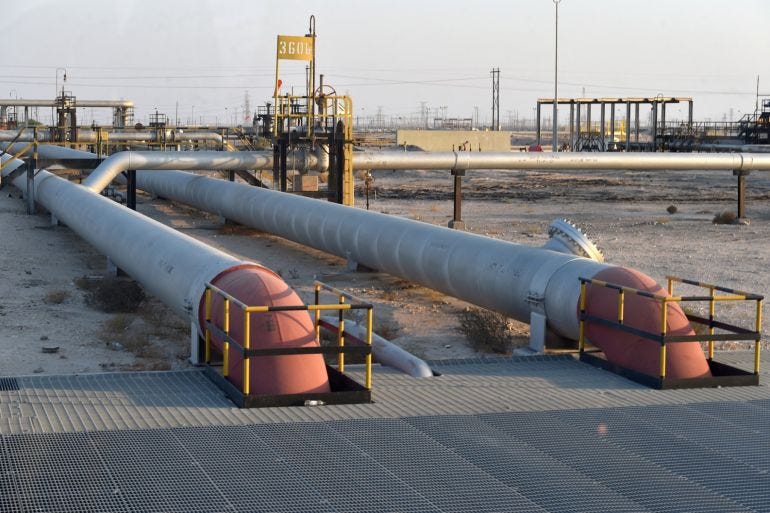
The Middle East already boasts one of the world’s largest networks of energy pipelines, moving critical commodities across large distances for internal consumption and export. The biggest and most important is the East–West Crude Oil Pipeline in Saudi Arabia, which has been expanded to handle about 7 million barrels per day (bpd) since the start of the war in Iran. That pipeline cuts over 700 miles across the Arabian Peninsula, moving crude from the oil fields in the country’s east to export terminals along the Red Sea in the country’s west, bypassing the chokepoint at Hormuz. The Abu Dhabi Crude Oil Pipeline is much smaller, handling about 1.5 million bpd, and travels a shorter distance, moving crude from areas abutting the Persian Gulf to ports on the Gulf of Oman, allowing tankers to avoid transiting the strait. There are other pipelines, both for oil and natural gas, running from Iraq to Turkey, Qatar to the UAE and Oman, and Egypt to Jordan and Syria. These pipelines are not currently able to handle the massive volume transiting the Strait of Hormuz by sea, but they are already significant bypasses to that waterway. And they have room to grow.
Constructing new pipelines is certainly a good idea for the Gulf states, as it would reduce Iranian leverage over the medium and long term. There are several factors that make this a strong investment for nations seeking to avoid an Iranian stranglehold over their economies. The Gulf states are extremely dependent on revenues from energy exports and have seen Tehran attack them directly; they have every incentive to reduce Iran’s power over their countries. These nations are non-democratic regimes with little in the way of procedural roadblocks to building new infrastructure. They do not need to deal with the eminent domain claims, environmental review processes, property rights, or lawsuits that slow major infrastructure projects in America to a crawl. These nations are also flush with cash and usually control these projects at the national level, removing many typical roadblocks to speedy development and construction. New projects could expand on existing infrastructure, connecting current pipelines to one another or growing the network to new export nodes. We could see more pipelines heading to Red Sea ports, as well as potentially northward and directly to the Mediterranean via nations like Turkey, Syria, Lebanon, and, if the Abraham Accords are expanded, perhaps even Israel.
While there is immense long-term promise in this approach, pitfalls abound. Huge infrastructure projects like this take time to build, despite the fact that Gulf nations have few of the regulatory hurdles that we do in the West. They are large-scale construction projects that require planning, purchasing, logistics, and financing. If they are crossing the entirety of the Arabian Peninsula, they are extremely long and will be passing through some of the most remote and difficult terrain on the planet. The center of the Arabian landmass is primarily inhospitable desert, alongside mountains and ridges that are challenging to traverse. Companion infrastructure — roads, railways, power transmission, water provision — is lacking as well, making the construction more time-consuming and demanding. Transnational pipelines bring additional hurdles, including diplomatic issues in a region that is infamous for its constantly shifting multilateral relations.
These pipelines are also not entirely immune to malign Iranian influence. Depending on the route, Tehran can continue to threaten ships carrying oil or gas. If the export terminal is in the Gulf of Oman, beyond the Strait of Hormuz, ships still need to pass within missile or drone range of Iran’s coastline before exiting to the open ocean. If the pipelines end at Red Sea ports in order to transit the Suez Canal or the Bab-el-Mandeb Strait, the threat of Iran’s Yemeni proxy, the Houthis, becomes salient. The Houthis have already demonstrated their willingness to attack shipping in the Red Sea, launching multiple attacks at commercial vessels during the Gaza War. These threats will only be fully avoided if the pipeline terminus is directly on the Mediterranean, a longer and more diplomatically complex route. Pipelines are ripe for attack or sabotage, either directly by Iran or via its terrorist proxies. They are static targets that run for hundreds of miles, exposed against the open desert, and damaging even a small portion of the pipeline may be enough to shut it down entirely, at least temporarily. Defending infrastructure like this is a significant challenge, whether from aerial threats or traditional sabotage operations.