

If you’ve been following the war against the Iranian regime over the past week and half, especially in legacy or social media, you will have been bombarded with a constant stream of negativity and criticism. We’ve heard that there is no strategy whatsoever, that American interests are not served by this war, that it is a waste of blood and treasure to combat the Iranian regime, and that there are several ways for this campaign to fail in the future. These are not all unfair critiques of a major geopolitical move by the Trump administration, but they are only one side of the ledger; there are just as many alternate views of the conflict that arguably have more merit. That they are, by and large, not receiving the airtime or promotion that the negative perspective has is telling.
The media opposition to this war comes in two primary flavors: the anti-Trump camp and the anti-Israel camp. The former is more liberal-coded, while the latter primarily resides on the far ends of the political horseshoe, linking the antisemitic online right and the progressive left. Normally at loggerheads, these disparate factions have tacitly joined hands in an attempt to incept a reality in which America is already failing. The coverage choices, the purported “experts” being relied on for analysis, the points of emphasis, the breathless doomsaying, the deliberate downplaying of American and Israeli military success, and the uncritical repetition of talking points coming straight from Tehran are all evidence of this deep-seated bias. They are not merely analyzing reality, but trying to warp the perception of it to support their preconceived narrative. The particulars of those narratives differ – some blame Trump personally, some blame “American imperialism,” others blame Israel and the perfidious ‘neocons’ for embroiling us in another Middle East regime change “forever war” – but all come down on the same side: Iran’s.
This has gone beyond expressing reasonable doubts about an American military campaign in which several servicemen have been tragically killed. It has moved firmly into rooting for our failure and trying to wishcast it into existence. They are no longer operating in our shared reality, but in one entirely of their own making, in which up is down and left is right. Their analysis of events is almost completely upside-down, painting obvious successes as devastating failures, all in service of a predetermined narrative that seeks to undermine the United States. Examples of this abound, but six are worth specifically countering given their prevalence and reach.
Iran is Winning, Actually
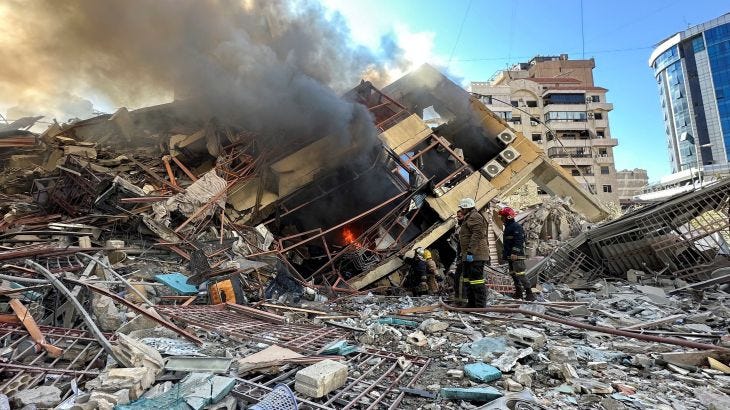
This is, by far, the most egregious of the bogus talking points that has permeated the online discourse surrounding the war. It is completely detached from the objective reality of the situation, often fully reversing the outcomes. We have seen claims that the US navy has been unable to operate for fear of its Iranian counterpart; in the real world, the Iranian navy is largely sitting on the seabed and America has a dominant position in the region. We have seen people aver that Iran “just defeated the combined military power of Israel and the US in less than two weeks”; the truth is the polar opposite, as Iran’s military is in utter shambles across all domains and the US-Israeli operation holds total air superiority over the country. We have seen the favorite guests of the isolationist, antisemitic, “America First” right, Scott Ritter and Douglas Macgregor, suggest that Iran has “already accomplished its primary goal,” despite all the evidence to the contrary. And we have seen a 386,000-follower Twitter/X account post this absolute gem of creative writing:
“Iran is waging an almost perfect asymmetric war, absorbing the attacks, strategically rendering the surrounding bases unusable, destroying radars, and maintaining control of the Strait of Hormuz while still preserving its missile launch capability. And it’s doing all of this after losing very little of its navy, air force, or overall arsenal, something we can easily verify by checking the visual evidence of losses. The US and Israel are in an extremely difficult situation because they only know one kind of war: brute-force destruction. Now they’re facing a strategically well-positioned Iran that is fighting on its own terms and timeline.”
None of this is true at all. Iran’s missile launch capability has been degraded enormously, with launches of drones and ballistic missiles down over 70% from the first days of the war. This is due to the aerial destruction of stockpiles, launchers, and factories, the three legs of Iran’s retaliatory stool. Most Iranian attacks have been targeted not at American and Israeli bases, the vast majority of which have sustained little significant damage, but civilian areas of uninvolved countries like Saudi Arabia, Bahrain, the UAE, Kuwait, Qatar, and Azerbaijan. This is not strategic, but haphazard and reckless. The Iranian navy, air force, and arsenal are largely unusable, either having been obliterated from the air or forced into inaction by the threat thereof. Tehran certainly isn’t fighting on its own terms given the immense damage it has already sustained – and we’re only two weeks in.
These are the worst offenders on social media, but their overall sentiment – that America and Israel are losing this war – has been repeated throughout the media. The chief foreign affairs commentator for the Financial Times quipped that “Operation Epic Fury is in danger of turning into Operation Epic Failure.” Outlets from the BBC to CNN have uncritically repeated Iranian regime propaganda showing serious US losses and strong Iranian resilience, only to be corrected by direct visual evidence provided by the American military. Politicians, pundits, and partisans alike have exaggerated Iranian strength and invented American and Israeli weakness. This is wishcasting of the highest order. It seeks to create a false narrative by slicing, dicing, and rearranging reality, ignoring anything contrary to the preconceived notion meant to become common knowledge. Every other ridiculous claim addressed below springs from this one noxious fountain.
Now the Real Hardliners Are in Charge
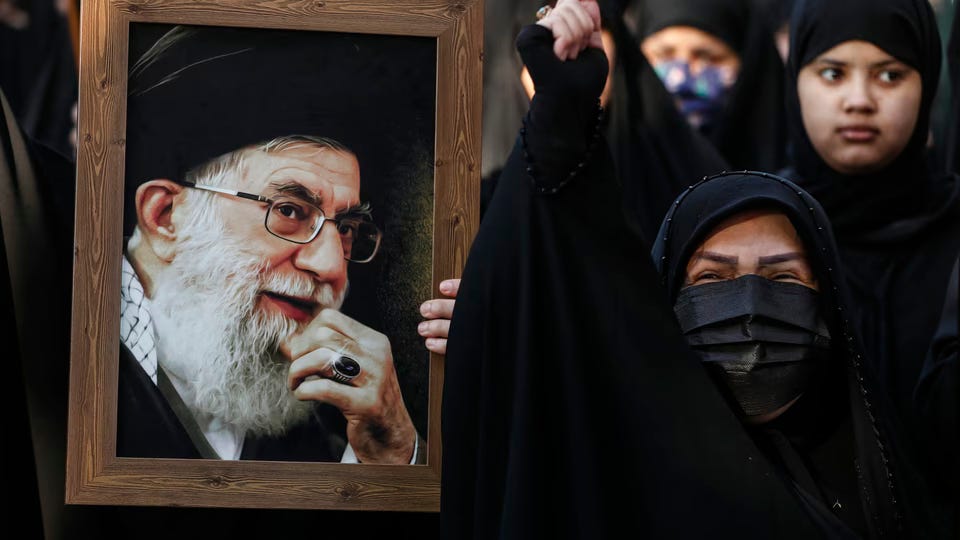
Another spurious narrative that has been promoted widely in the media is that the killing of the Ayatollah and much of the military and leadership hierarchy has empowered the real hardliners in the Iranian regime. According to these outlets, the newfound vigor and radicalism of this recently-elevated faction will spell doom for America and Israel, thus making this operation a total failure. A similar talking point, espoused by some on the isolationist right, is that all we have done is replace one Khamenei (the late Ayatollah) with another (his son, Mojtaba, who was declared Supreme Leader this week), once again proving our ineptitude. After all, what did we even accomplish if the new leaders are the same as or worse than the previous cadre?
To understand the innate wrongness of this argument, we must go back in time to the Obama administration, when this term – hardliner – became widely popularized and routinely used as a cudgel against those who opposed that president’s nuclear deal. Back then, these mythical hardliners were always lurking in the background, threatening to take over and make things worse for America if we didn’t kowtow to the purported moderates who were running the country at the time. Fast forward a decade or so and the term has returned with a vengeance, used primarily by the same people and media mouthpieces that pushed it then. And they’re using it for the same cynical purpose: to denigrate any and all action against the Iranian regime.
In short, there are no moderates. Everyone is a hardliner.
The problem is that the hardliners were always in charge. There were no moderates. Even the most milquetoast of Iranian political or military figures have dedicated their lives to the destruction of America and Israel. The same Ayatollah ruled over the country since 1989. The totalitarian nature of this millenarian theocratic regime has never changed. The moderates during the Obama administration were fresh off the killing of hundreds of US troops in Iraq. They were actively engaged in building a nuclear weapons program and a ballistic missile arsenal with which to deliver them. They were funding global terrorism and driving the devastation of the Syrian Civil War. The current crop of moderates (often the same people) launched a genocidal war of extermination against Israel in 2023, attempted to close the Red Sea and Suez Canal to international shipping, launched attacks on regional oil infrastructure, and provided the drones by which Russia has assaulted Ukraine. Oh, and they just murdered over 30,000 of their own citizens in a weekend. In short, there are no moderates. Everyone is a hardliner.
Given that core truth, what we have gained from these decapitation strikes is clear. We have killed the most experienced, well-known, influential, powerful, and meaningful figures in the entire Islamic Republic of Iran. The men who would run a war, order the mass repression of civilian unrest, work closely with allies (our enemies), stifle internal dissent, and present a strong face to the world were dispatched in one fell swoop. This was an absolute coup. Now, the military apparatus of the regime is dispersed, isolated, and disunified, making it much harder to consistently act in force against America, Israel, and the Gulf States.
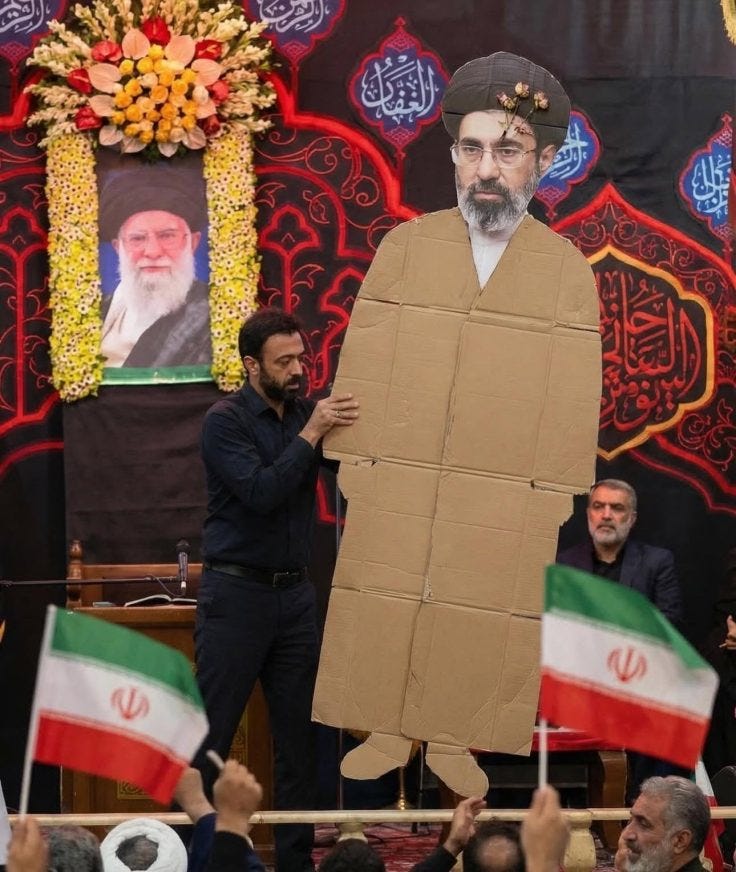
As for Mojtaba, several factors make his choice less of a danger than the media is posing it to be. First, he very well might be dead. The strike that killed his father seems to have seriously injured him, as he has not made any public appearances since being elevated, nor has he spoken to the nation as promised. In a genuinely hilarious turn of events, he was represented by a literal cardboard cutout at a “major” pro-regime rally – no, I’m not making this up. Second, if he isn’t dead yet, he probably will be soon. The new leader is immediately a target for assassination, and I don’t doubt that Israel would be able to pull that off. Finally, the younger Khamenei’s elevation to Supreme Leader, reportedly at the behest of the IRGC, undercuts one of the regime’s main claims to legitimacy: the fact that it was not a hereditary monarchy. Replacing one Khamenei with another puts the lie to this claim, removing one of the few things that made the clerical regime ‘better’ than that of the Shah. Altogether, replacing one Khamenei with another is a pretty damn good outcome for the first 10 days of the war.
China is the Real Winner
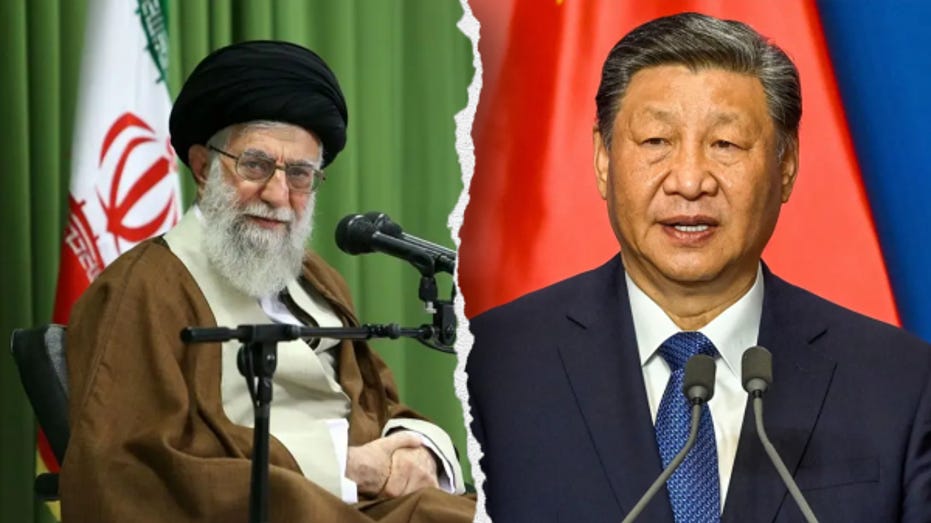
This talking point has rapidly proliferated across social media, largely by accounts that seek to focus entirely on the threat of China and ignore other regions. (I have long been a proponent of focusing on the Indo-Pacific as our primary theater of geopolitics, but that does not mean that we should ignore everywhere else.) They argue that since we are now ‘bogged down’ in the Middle East once again and using some of our weapon stocks to defeat the Iranian regime, the Chinese government will benefit and perhaps even invade Taiwan while we’re busy elsewhere. This argument fails in a number of ways. First, as I laid out in my essay on the subject for Junto (see below), the attack on Iran is a slap at China, too. It reduces, if not outright removes, a major source of cheap oil for Beijing, without which an invasion of Taiwan is less likely. If China does not have ample fuel to power its war machine, it cannot get said machine to work in an optimal manner – something it will have to do to successfully invade Taiwan. Iran is a major hub in the sanctions evasion network, allowing rogue regimes across the planet to avoid America’s powerful financial penalties. Cutting off that expertise and routing node will make it harder for Beijing to sidestep our economic weapons. Tehran is also a close ally of Beijing; weakening or removing that regime from the playing field hurts China immensely.

When it comes to using stockpiles for this mission, thus reducing our capabilities in the Pacific, the narrative also fails. Weapons and ammunition are not just for show. They serve as a deterrent to action, but their primary purpose is to be used to defeat our enemies. And that is just what they are being used to do now. The temporary relocation of assets to the Middle East will not permanently undermine our deterrent capacity in Asia, no matter how many times analysts claim it will. Stockpiles are already being replenished under last year’s defense budget and in concert with America’s defense industry – the Trump administration is proposing an even larger military budget for 2027, which would include plenty of money to refill stockpiles. We are also able to use less advanced and expensive munitions due to our overwhelming success thus far, opening the skies over Iran for safer and cheaper bombing runs. At the same time, China cannot invade Taiwan on a whim or at a moment’s notice. It took us months to build up our forces in the region to handle the current war on Iran, a far less complex undertaking than a massive seaborne invasion across nearly 100 miles of open ocean. The threat in the Middle East was imminent compared to the medium and long-term threat in the Pacific. Taking out Iran now helps pave the way for a better defense against China going forward.
The Nuclear Lie
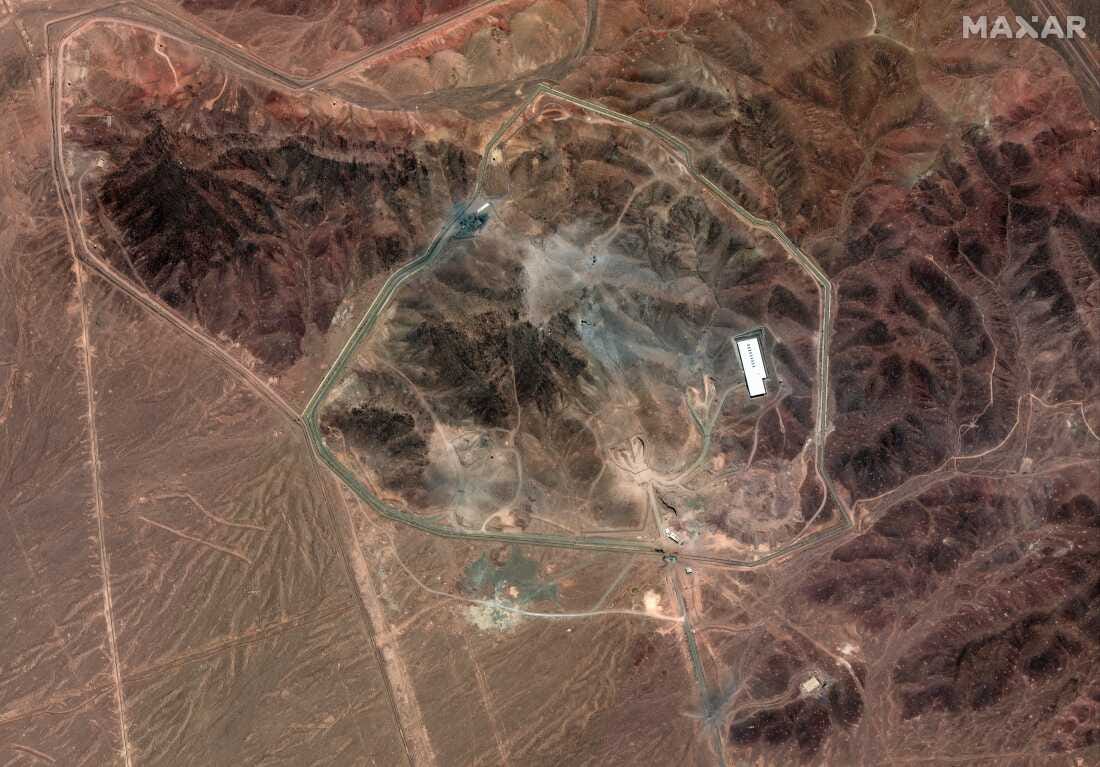
Opponents of this war have suggested that one of the stated rationales for this conflict – Iran’s continued efforts to develop nuclear weapons – is a red herring. They say that the Trump administration is either lying now about the continued Iranian program or was lying last year when they said it had been largely destroyed. But these are not mutually exclusive claims. The highly-advanced Iranian nuclear program was heavily damaged in Operation Midnight Hammer in June 2025, when American bombers struck several nuclear sites, demolishing key equipment and burying more under tons of rubble. Those strikes did indeed significantly degrade the program, setting it back years. The president, with his usual exaggeration, claimed it had been “obliterated,” but the less hyperbolic members of the administration explained the damage accurately. At the time, the president stated that, if the Iranian program were to restart, we would destroy it once again.
That sets the stage for the current day. In the past eight months, the regime has indeed tried to reconstitute its nuclear program, albeit in a different form than before. Instead of focusing exclusively on creating miniaturized nuclear warheads deliverable by ballistic missile to nearly anywhere on Earth, they have worked to simply achieve the most basic nuclear weapons possible, akin to dirty bombs. This gives them the ability to threaten nuclear destruction sooner, even if it is less credible in some ways. But combined with the regime’s global terrorist network, even these basic bombs could be devastating. The mullahcracy was rapidly moving in this direction, as well as building as large a short and medium-range missile arsenal as possible so as to deter strikes like those of Midnight Hammer and Epic Fury. Had they succeeded, they would be on a glide path to nukes. The regime having a dangerous nuclear program now does not mean that their previous dangerous nuclear program was not mostly destroyed last year. Those who claim otherwise have either been fooled themselves or are trying to fool you.
The Venezuela Playbook Failed
Outlets as respected as the Financial Times have published stories suggesting that the Trump administration tried to use the same tactics as it did in the Maduro capture operation in Venezuela against the Iranian regime, but failed spectacularly. They suggest that the widening of the war and the replacement of one radical Khamenei with another radical Khamenei shows the truth of this botched operation. The problem with this assertion is that it is patent nonsense. The plan was never to do a snatch-and-grab of the Ayatollah and engineer his replacement with a pliable tool at the top of the regime; it was to defeat the Iranian threat and create the conditions under which the Iranian people could successfully overthrow their oppressors. This was clear from the get-go, with the military objectives outlined by several administration figures falling directly in line with this approach. And this was even predictable before Operation Epic Fury commenced, as the American military buildup in the region far outpaced that of the Venezuela theater. Any action taken against the Iranian regime was destined to be more extensive and longer lasting due to the assets being moved into the area and the nature of the regime itself, something the administration has been clear-eyed on. The Venezuela playbook didn’t fail in Iran because it wasn’t even on the table in the first place.
War Crime via Submarine
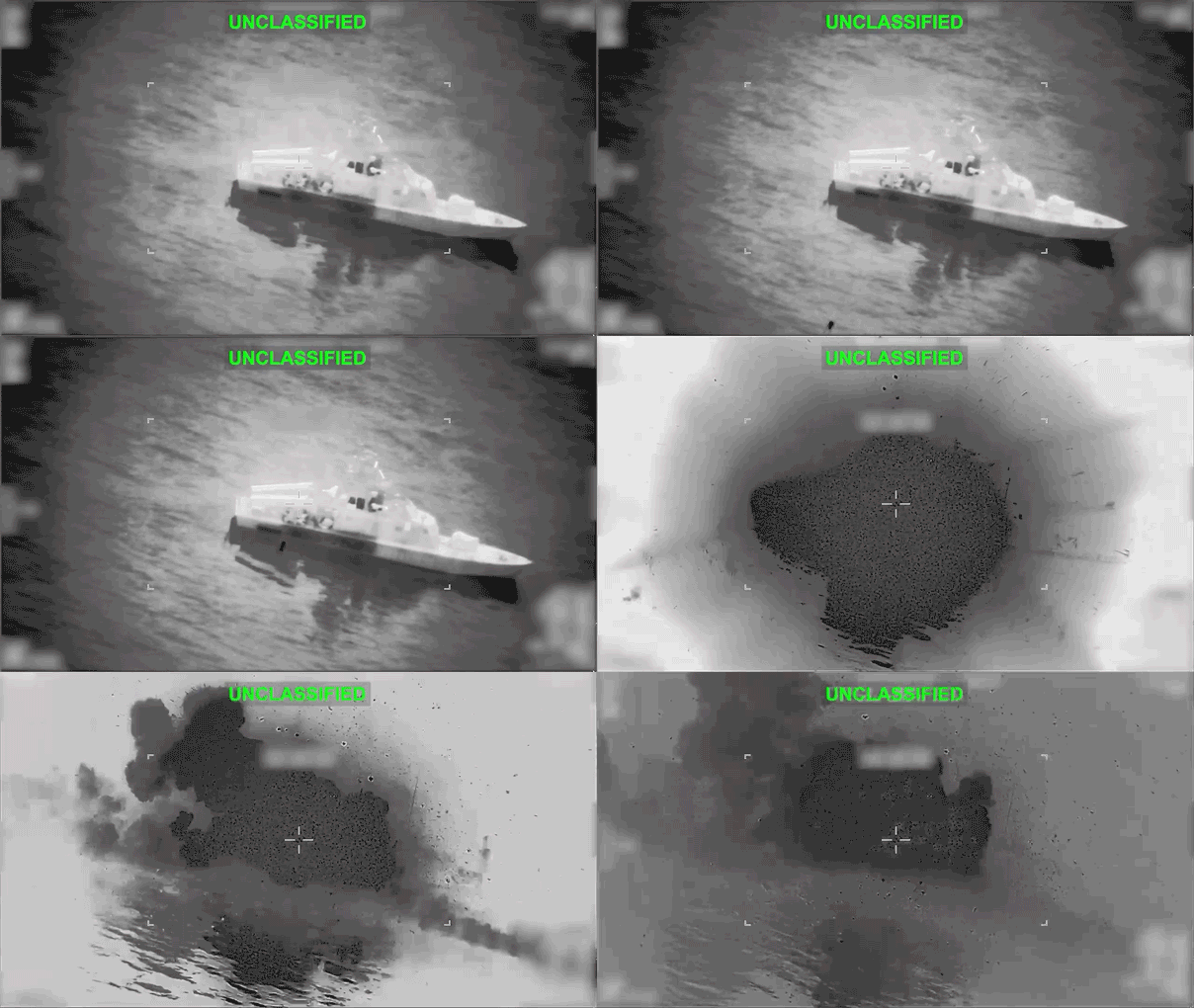
As with any American military expedition, the cries of “war criminal” have already begun to echo throughout the media ecosystem.1 The most spurious version of this allegation stems from the sinking of an Iranian frigate, the IRIS Dena, by an American submarine in the Indian Ocean, off the coast of Sri Lanka. Several so-called ‘experts’, notably one Tom Nichols (a former professor at the Naval War College), claimed that the use of a submarine and the choice to sink the ship were both unnecessary and quite possibly unlawful, suggesting instead that the US Navy use a surface warship to capture the boat. Some went further, claiming that the Iranian ship was both unarmed and caught completely unaware without any warning whatsoever. They aver that these circumstances, plus the distance the frigate was from the main battle zone and the lack of a rescue attempt for survivors, made this sinking illegal.
Reader, I’m going to be blunt: this argument is complete garbage. The United States is under zero obligation to allow an Iranian frigate to return unmolested from a naval drill to threaten other American warships, no matter how far it was away from the Persian Gulf. Additionally, the area in which it was sunk was directly astride the critical sea lines of communication used by US forces to coordinate and deliver logistical support to the campaign in Iran, making the ship into a more direct threat. There have been reports that the submarine did indeed warn the ship – a warning that went unheeded – that the frigate was indeed armed, and that there was at least one other Iranian vessel in the general vicinity to engage in search and rescue, alongside the Sri Lankan ships not too far away.2 The fact that we used a submarine instead of a surface ship is immaterial besides the fact that it is both cool and uncommon. Indeed, this decision endangered fewer American lives than any attempted seizure would and gained the objective more easily and effectively.
It was not only not a war crime; it was exactly how we should carry out a naval war. You’d think that a lecturer at the Naval War College, of all places, would understand that.
There are myriad other ludicrous arguments against this war, all trying to preemptively paint it as a strategic and tactical failure. But the key thing to remember here is that it has been less than two weeks. Trying to present this war as a long-term strategic failure is laughable this early in the game, especially as we have not even seen the heaviest and most significant attacks against the regime yet. Ignoring the obvious tactical successes – or worse, imagining them as failures – presents a totally false notion of what is happening in reality. Let’s be perfectly honest about this: it is a deliberate choice meant to sow public distrust of this campaign and shape its outcome in a negative manner for the United States and a positive one for the Iranian regime.
For social media influencers who earn their keep by parroting the propaganda lies of our enemies, this is to be expected, if still countered vigorously. For American media outlets, politicians, and pundits, it is tantamount to rooting for your own countrymen to die. Whether they reached this sad state of affairs because they despise the president personally, hate Israel (and the Jewish people), or think America is a bad actor globally who deserves a comeuppance matters far less than the fact that they have reached it.
Beware those who are pushing this false narrative, regardless of why they are pushing it. They do not have America’s best interests at heart. Some are actively working against our interests and in tacit support of our enemies. Remember the people who are imagining American failure and rooting for it to happen. But don’t listen to them.
The accusation that the US unintentionally struck an Iranian girls’ school in the early hours of the war has been largely substantiated, although it is no war crime, but a tragic error. The school was located on the grounds of a military base and had formerly been used for military purposes, showing this to be a horrible targeting mistake. This sort of thing is unfortunately not uncommon in warfare, but the US does about as good a job as anyone in avoiding them. On the contrary, the Iranian regime deliberately strikes civilian targets with its weapons, engaging in actual war crimes on a daily basis. The difference in coverage between an American error and an intentional policy of civilian harm by Iran is stark and reveals the media bias at play.
Submarines are also not exactly famous for having plenty of extra space to pick up survivors of a distressed vessel.
I'm an American and I want Iran to win. Thankfully, they are doing great so far and are winning. The zionist entity has been such a tumor and parasite on the United States and has done so much to hurt our standard of living. It's great to see Iran dealing these tremendous blows to the evil US occupation government.
Americans and Iranians want to live together and have great relations, it's only the evil zionists who get in the way. Btw, the zionists are responsible for destabilizing the middle east, leading to mass migration to Europe and the US.